Exactly my point, ill design a base valve, then make it, then you buy it and do whatever you want with it. Whether that's a hyper performance gun with a delrin bolt, or a durable good performance gun that can also be used as a hammer.
-
The Maniac Inside -
I'm not an engineer but once upon a time this was a bi-weekly discussion on AO. If you could figure a way to maintain the recharge rate and lower the pressure I would be very surprised. Show me 32 CPS with zero shoot down (in fact some shoot up) at 200psi. It seems counter intuitive. I'm also fairly certain that the high pressure = low efficiency thing is a myth. The volume of air required to accelerate a paintball up to 300 fps is the same regardless of input pressure.
If a paintball is going from zero - 300 fps in the first 8 inches of a 0.689 barrel then the amount of air being dumped behind the ball has to be equal regardless of the platform delivering the air. What makes MAGs seem inefficient is there inability to shoot "to the bottom of the tank".
Again, I'm not an engineer, but seeing is believing and so far everyone who has promised this has delivered hype and nonsense. I wish you luck.
~PatronComment
-
While your base theory on low vs high pressure on efficiency is somewhat correct, the gap between the paintball and the barrel allows air to escape. High pressure air escapes at a faster rate causing more waste, lower pressure still escapes, but at a slower rate. This means that low pressure air loses less energy in the barrel than high pressure air, allowing you to use less energy (air) to get a paintball to the same velocity. Also a lower pressure volume of air does not expand as quickly or violently as high pressure air. This means that once the air escapes the barrel there will be a lower power/speed pressure wave meaning less sound. It will also accelerate the ball more gradually meaning it is more gentle with paint.
I can get around the recharge/shootdown issue in low pressure markers simply by updating the regulator. These days markers are capable of a low pressure stream of 35+ bps paint with no shoot down.The Maniac InsideComment
-
According to this thread:
The peak pressure behind the ball coming from a "high pressure" E-mag was only 60psi. Lower than the Cocker, Impy, Angel, and Matrix at the time. If I'm reading the graph properly, the pressure falls off far more evenly than it's contemporaries. This would seem to directly contradict your notion. While the Mag's operating pressure is higher (to increase cycle speed), the volume and pressure of air behind the ball is as low as the lowest of "low" pressure markers at the time.
Are todays markers dumping air at less than 60 psi behind the ball? If they were they would be needing longer barrels would they not?Comment
-
For further research you might consider investigating the "Flex" valve that Tippmann is using in the phenom. It does not use the on/off assembly from the Automag design, thus circumventing any patent infringement, but it is a low pressure regulated blow forward design with 30bps ROF capability. Keep in mind if you do build a valve utilizing the on/off assembly and sell it for a profit you would be violating the patent on the Automag valve.
An extremely low pressure, efficient mag has always been a "dream" design of mag enthusiasts. But like the previous poster brought out, Mags already run at pretty low pressures. Internally at about 325 and at the ball 60 PSI. How low do you think you can go and move that bolt fast enough and fire at velocity?
You claim high pressure gas escapes "faster" around the ball than low pressure gas? Isn't that proportionate also? If the gas is pushing the ball faster and escaping faster, then a slower ball push, would mean a slower gas escape, but a longer time in the barrel, meaning it would still lose the same amount of gas over a longer period of time. Doesn't that balance out?
Velocity, mass, and energy are all calculated fields. There is no real guesswork here. It should all be able to be calculated. I am no math genius by far, but I'm assuming you should be able to mathematically prove your idea before you even bother going into any kind of production.
I would love to see the math.
SandmanAGD is in the house!
Custom gun builds. All the parts. New Website. Factory Service available!
www.airgundesigns.comComment
-
The air pressure dilemma is not always as easy as looking at the pressure available. It takes a certain amount of force to accelerate the ball up to the desired velocity within the confines of the length of the barrel. That force is delivered by air pressure on the back of the ball. Now, this is where it gets dicey, and the different delivery mechanisms actually make one better than another.
The theory is that low pressure is more efficient. The truth is, that they are both equal. A large chamber at a lower pressure delivers the same energy as a small chamber at a higher pressure. The inefficiencies come in the delivery system. This is where the air gets choked off as it fills the void behind the ball. If you could magically open the front of the valve instantly without any restrictions for both a high pressure or low pressure chamber containing the same energy, they would both shoot the ball at the same velocity.
Low pressure systems are more efficient in current designs due to their delivery systems. The chamber has less restriction when opened so the lower pressure air is more fully available without restriction. Therefore, it actually pushes the ball down the barrel rather than chasing it down the barrel after the initial impulse of air is released. You could make these delivery systems much more efficient using a smaller chamber and higher pressure, but the machining work and tolerances would need to be much more precise to prevent the orings from binding. Plus, most of the small solenoid switches don't handle higher pressures well. Changing these parameters to operate at high pressure would drastically increase the cost of the design.
The high pressure systems on the market today use alternate methods of delivering the air from the front chamber. Many use a poppet valve. These actually work really well for a simple design. The puff of high pressure air released when the poppet is opened has a short, high pressure impulse force so it pushes the ball rather efficiently without much trail-off of air.
The mag uses a spool valve. The inefficiency lies in the bolt spring. It keeps backward force against the bolt and acts like a regulator for the air flow. That means that the ball can get away from the air supply after the initial high pressure impulse, because the regulated air escaping around the back of the bolt cannot maintain enough force to push the ball. Only the initial impulse can propel the ball and all other air following that is just wasted. A lower force differential and resulting slower bolt movement caused by a level 10 bolt setup makes it even worst, which is why efficiency went down when level 10 bolts were introduced.
If you want to truly make an efficient gun/valve design the mag valve is not bad. You just need to get rid of the bolt spring so that the valve fully opens without restriction and will immediately dump all of the air behind the ball. That will cause you to use a lower pressure to reach a higher impulse pressure that can be maintained longer, which will give great efficiency. Now you just have to figure out how to reset the bolt. I would use a pneumatic piston of some sort. Removing the bolt spring would also allow you to use a lighter material for the bolt which would make the bolt more responsive and easier to maintain a level 10 anti-chop mechanism while keeping the smooth consistent operation needed for minimal velocity fluctuations.Except for the Automag in front, its usually the man behind the equipment that counts.Comment
-
To further further touch up on what's been said recently, about the gas escaping around the ball at any pressure... isn't that why every company out there makes a paint match barrel system?
I know its an "accuracy enhancing" feature, but if you match the barrel/ paint there should be minuscule blow by on the ball.
I also think if this were highly probable agd would have done it years ago, and called it the "fastmag"Comment
-
I like the idea of eliminating the spring and using a pneumatic ram to reset the bolt. I wanted to give it a shot but short on money and skills. Eliminating the spring should increase efficiency correct? Then use a light weight bolt as well.Comment
-
Ok, sit down this is gonna be a long one.
First, I have seen the graphs, and while yes the high pressure mag was the most consistent if you notice, the other markers have a higher MOI (moment of impulse) A higher MOI means less force acting on the paintball at once and thus less stress on the shell. So while the consistency of the automag is desirable, the short MOI is not.
The best combination (here comes the math) is found by taking tha area under the curve of a hypothetical shot at the desired velocity, finding the total work that needs to be done on the ball to bring it up to the desired velocity, and then tuning the curve so that the valve closes the moment the ball reaches then end of the control bore. After that you will have the desired MOI. Then you divide the work needed to accelerate the ball by the MOI and that gives you the momentary energy needed for the duration of the MOI. You can then convert units and find the required psi behind the ball.
For most control bores this works out to about 45psi behind the ball for about 1.4ms. This is of course assuming a perfect ball/barrel seal. Depending on the volume size this alters the actual operating pressure of the gun (I have yet to work out a formula for this).
As far as the valve goes, the Automag is a blow forward spool valve. Unlike poppet valves these are proven to work more smoothley and efficiently at lower pressures. I could eliminate the spring by using a three way fo feed air between the chamber and bolt lip (much like current spoolies) but that introduces reliability and durability issues. I was thinking of perhaps adding a compressible buffer in front of the spring. This means a lighter spring without damage to the gun. A lighter spring reduces the regulator effect because a lighter spring requires a lower pressure to influence the spring.
Id rather not use a hydraulic rammer for this purpose because its use of gas defeats its own purpose. It also introduces reliability issues.
After more math, I have decided that I will attempt to use delrin on the bolt tail. This would reduce the coefficient of friction. And also be fairly simple to change should it break. I have also settled on 7075 aluminum an a bolt material. It would take the abuse but also cut the weight way down from the steel lvl 10.
Finally thanks for the input. Keep it coming. Ill keep updating on progress through this thread.Last edited by FPSmaniac152; 01-30-2013, 09:37 PM.The Maniac InsideComment
-
The ball takes about 3.5ms to exit the barrel. At 14ms you would need a really long control bore.
The gas you use to push back the bolt when the chamber is empty would be less than the gas lost using a spring that acted as a regulator choking off the air flow, even a light spring. You could use a light spring that wouldn't be a problem, but then you would not have any real return force to work with and the bolt action would be slow resetting.Except for the Automag in front, its usually the man behind the equipment that counts.Comment
-
wow just thought i was in dynamics, structural mechanics and materials science all at once. lol looking forward to seeing the end resultComment
-
Sorry, as for the MOI I forgot a decimal point, the correct number is 1.4ms, keep in mind this is for the control bore in a boring kit, not the complete barrel.
The reason I don't like the rammer is the same reason I don't really like cockers. As soon as you need that rammer you need a 3 way valve as opposed to the current 2 way, then to maintain efficiency, you would want to use an LPR. More complications. And don't forget the rammer itself. Remember the beauty of the automag is its simplicity. I am trying to improve the gun in terms of function as well as simplicity. Adding all that stuff defeats the purpose of the automag.
REMEMBER this is to be an improvement over the current x valve, not the absolute limit of what the automag can be pushed to do. It also needs to be relatively cheap (around $300) and producable. Adding absolutely everything makes that nearly impossible.
Keep the suggestions coming, just keep the whole cost thing in mind when you mention things, Im not trying to make a $1000 valve.The Maniac InsideComment
-
The 1.4ms makes more sense. I know what you mean about the 3-way valve. Given that the overall chamber pressure will probably be quite low, you might be able to use one of these without an LPR which would help. It does make the system more complicated, though. I hope you do find something that works. It would be nice to have some new innovation to our existing design.Except for the Automag in front, its usually the man behind the equipment that counts.Comment
-
I have given somt thought to doing an air spring in place of the current spring. This could be done by using a 3 way in place of the current 2 way (where it turns both on and off at the same time) and directing air to the front of the bolt after firing to recock, then maintaining this pressure until the marker is fired again. This air pressure would work as a fluid sear and once air from the 3 way was deactivated, the air in the shot chamber would propel the bolt forward.
Only problem is, now were dealing with a totally new platform, making all existing bodies etc. unusable.The Maniac InsideComment
-
Your argument about MOI seems to directly contradict your notion of higher pressure behind the ball. You seem to have a good idea of what you are talking about but it always annoys me when people don't acknowledge when part of there argument has been defeated. First you said you wanted to go low pressure to improve efficiency. You said that higher pressure behind the ball lead to energy loss. When it was demonstrated that the Automag valve uses the same volume of air at the same pressure (or less) than it's contemporaries you dumped that argument and (in what appears to be a complete 180) switched to this notion of needing a shorter MOI. That seems to directly contradict your concept of higher pressure = loss of energy.
Also, look at the graphs again. The time scale is different in each graph. When read using the actual figures the MOI (amusing this means the start of the curve to its peak) is almost identical across all markers tested. Between 10 and 35 with the Mag falling at 15. I don't know what unit of time this represents, only that it is uniform and contradicts your notion of MOI being longer for the Automag as shown in those graphs. If you mean the entire length of the curve, only the Angel has a shorter instance (Mag = 45, Matrix = 75, Impulse = 65, Cocker = 200!, Angel = 35).
The only concept posited in this thread that seems to hold any water is athomas' concept of energy being wasted moving the spring forward. This seems extraordinarily marginal given that it only takes 6-8 psi to advance the bolt. The level 10 properly installed only costs 1 out of every 60 shots in efficiency. There is a data thread for that as well if you want me to dig it up for you. The real cost of the LV10 is in maximum cycle speed since it slows down a portion of the bolt stroke.
The solutions being offered sound an awful lot like the "lets turn the mag into a cocker" stuff that used to fly around in here all the time. You are right about keeping it simple. In my experience simplicity = reliability, efficiency, ease of use. The spring is not there to regulate the pressure in the chamber behind it. It is there to assist the blow back (yes, Mags use blow back) in re-cocking the bolt. Once cocked it is the sear that holds it back, not the spring. If you don't believe me, (don't do this) cut the front of your sear off and see what happens.
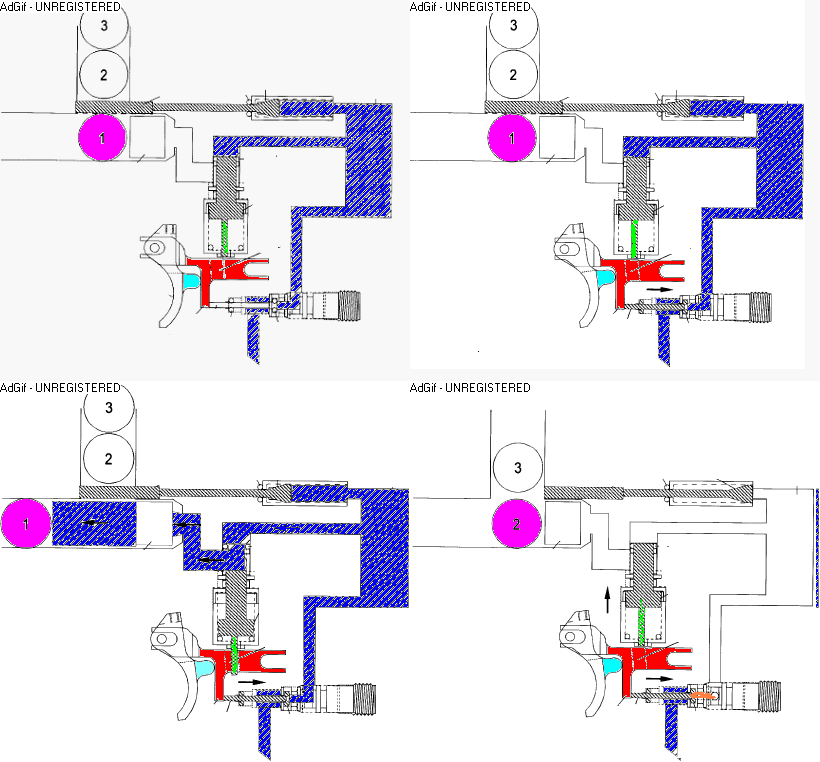
The reason for the bolt travel is to chamber the round. The internals of the power tube where designed at the length they were to accommodate that very specific travel. So the solution is not to contrive some new means to reset the bolt, but to eliminate the bolt altogether.
ICE EPIC! lol
I'm not sure that that counts since it's really just moving the "bolt" to above the ball and calling it a trap door. Since most loaders are force feed now, you could conceivably use an actual trap door that would be force closed by the blow forward and forced back open by the force feed. Just a thought.Comment


Comment