-
-
My reverse minimag valve I had was the same length as my classic RT valve. And I know for a fact a classicRT and RTPro valve are identical other than OD considering I own both. Along with that. A RTPro back half and classicRT back half can be interchanged and work perfectly..... Well other than the rtpro back being to large to fit in a classic rt.Comment
-
Surely with some of the agd hoarders on here. Someone has 1 of all the valve styles from mid 90s upComment
-
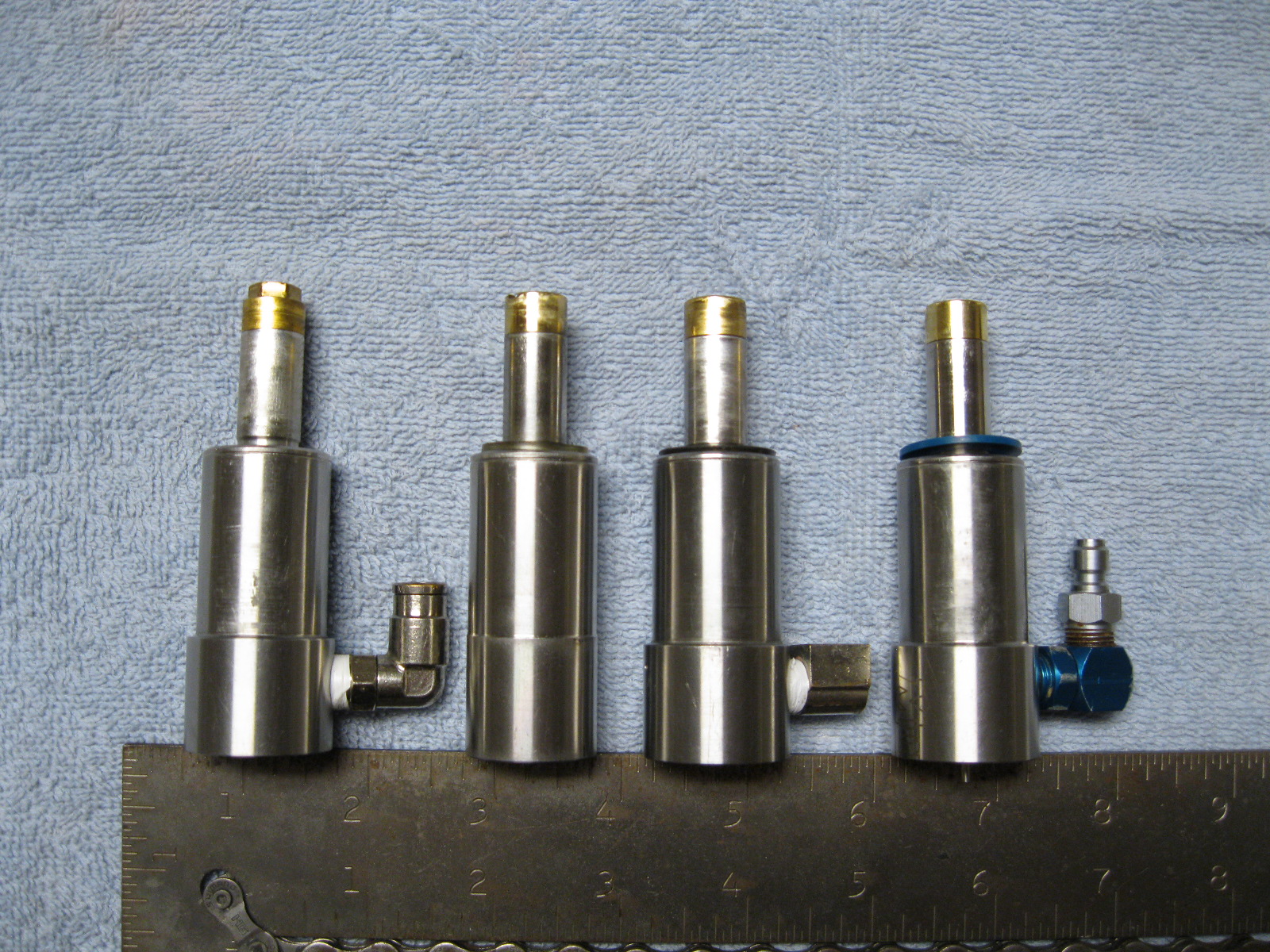
valve fronts. from left to right: emag, rt classic, rt pro and minimag. they are all exactly the same length. the emag is only longer due to the lvl 10 powertube tip.

valve regulator backs. the emag, rt classic and rt pro are the same length at 1.492". the minimag is 1.315". the measurements were taken with digital calipers.

there is no reason to suggest the x-valve is any different from the other rt valves regarding dimensions. they have the same internals, so they must have the same inner dimensions, and should have the same outer dimensions. the other rt valves all have aluminum reg backs as well, and are compatible (barring the rt classic) with each other as far as fitment into bodies, etc is concerned.Comment
-
3) Two springs in parallel have a lower oscillation period than a single spring with the same spring constant. That allows the regulator to be more precise and faster to react to any changes in pressure.
4) All springs wear out if the number of oscillations above a given stress level are exceeded. Most springs should handle millions of cycles within their parameters if the fatigue levels are not exceeded. that is much more than the life of a mag valve, especially since these springs don't move much.
5) The early RT, retro, emag valves had the single on-off hole to cut down on the parts needed. It eliminated one oring. Later emag and retro valves and all X-valves went back to having two orings. I suspect it was because the machining process was much easier.
6) The threading on the retro valve bodies is different from the classic bodies so that you can't install one on the other by mistake.
7) Yes, the back cap is stainless. Good cuts of lots of very fine threading allows a good mate between the threads. The number of threads in contact with each other is a high number which reduces the amount of force on any one point. The spread of the force over a large area keeps the force threshold below the value that the oxide layer breaks down which prevents it from wearing out.Except for the Automag in front, its usually the man behind the equipment that counts.Comment
-
Wow.
Just perfect. Thank you all, gentlemen! I'm in your debt.
athomas, just to clarify, are you saying that some of the later ReTro valves went to the double o-ring well just as with the E-mag, or are you lumping the RT Pro valves in with the ReTro valves for simplicity?
Did all, some, or none of the RT Pro valves have the double o-ring well?
Thanks again.Last edited by Menace_AO; 06-07-2014, 08:38 AM.Comment
-
I did link the retro and RT pro valves together, since they are essentially the same valve. All of the early "retro style" reactive trigger valves had the single oring well. All later versions had the double oring well. All RT valves and RT Pro valves were early valves, so they all had the single oring well. Only the retro and emag valves came in both flavours as far as I know. If you see any RT Pro valves with a double oring well, it was probably machined that way after the fact so that it could have an ULT installed.Except for the Automag in front, its usually the man behind the equipment that counts.Comment
-
Thank you, sir!
I'm now asking for specifics simply for the purpose of going into the market to get one of these older stainless bodied valves, but just want to be sure of having the double o-ring well, preferably factory machined.
In other words, I want to know with precision what to look/ask for.
Thanks again.Comment



Comment