
You know the effect that makes golfballs slice and curveballs curve? I know there's a name for it.
-
magnus effect
-
-
but Bernoulli is only for airfoils of some sort.....Origninally posted by warbeak2099
Definately extra lube. I keep two bottles at all times. Can't leave home w/o your lubricant.

My FeedbackComment
-
bernullis principle deals with the velocity of air and the pressure changes associated with it.
magnus effect is what you are looking for. but the magnus effect is based on bernullis principle. BHH!! one step above
Comment
-
I thought the Bernoulli affect (principal) dealt with produced vortices from spherical bodies
I did a project on it years ago....Comment
-
-
Would it be the Atkins diet?
Comment
-
dannielle bernouli explained that fast moving air is at a lower pressure than slower moving air.... this discovery had no bearing on airfoils until it was coupled with the coanda effect... the coanda effect is the one that says that fluids (liquids and gasses) will follow the curvature of solid objects that they pass over... kinda like a spoon or baloon under water... the water will wrap around the curvature of the curved surface... when that is coupled with the fact that the distance around teh curvature of the spoon is longer than the distance down its dished side (straight line at the rim diameter) then you get lower fluid pressure on the curved side...
initially D. bernoulli was explaining how sailing ships could sail into the wind, so long as they sail at a tack...
whatever that is, its true that the magnus effect is the one that explains the areas of low pressure around spheres that are spinning in a fluid..
-kyroComment
-
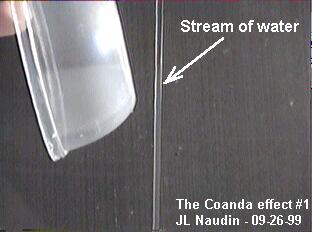
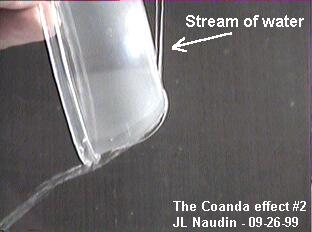
yes its the coanda effect. . i did a report on that last year. it is what creates the lift from backspin, like with a flatline barrel, and is also what causes lift in an airplane, contrary to the popular beleif. you can prove the coanda effect if you take a thin strip of paper (like 1 cm by 10 cm) and create a curve in it, and then hold one end of it with the convex side up, and blow along the strip. the piece of paper will lift and straighten out. you can also test this by running the water in your sink, and touching the convex side of a spoon (or other curved object) to the falling water. this will cause the water to change course:
 xvalve, ule body, logic vert frame, WWA barrel
68/30 PE nitro tank
cp unimount
halo BComment
-
2 words: Boundary Layer.
Read Schlictings book. Its all about the boundary layer which is important and deals with how a spinning ball rises. Also how a dimpled golf ball flys further, and why some airplane designers are experimenting with holes in airplane wings.Comment
-
damn, and all this time ive been throwing out those dimpled paintballs!! jk, they probably have to be evenly dispersed...Originally posted by yengese xvalve, ule body, logic vert frame, WWA barrel
68/30 PE nitro tank
cp unimount
halo BComment
-
Originally posted by slade
I am not fully educated on the subject currently slade, but i have had a great deal of past experience in the field of aeronautical engineering... for some time i was designing airfoil shapes for RC plane companies and for experimental civilian aircraft...
what you point out as the coanda effect is true about fluids following a solid surface, the only problem is this: the coanda effect only explains that the liquids act as they do and does not speak in respect to flight or the reason that air/hydro foils act as they do in a fluid... the coanda effect speaks to how fluid molecules act as a solid passes through them...
so, the process in which one side of a foil has lower pressure of fluids which are "coanda-ing" over it than the other side could be loosely described as the bernoulli principal.
so its like this.:
-as a result of the coanda effect, bernoulli's principal is possible..
-as a result of bernoulli's principal, newton's 2nd law can be applied to describe the reaction of hydro/air foils through fluids... i.e. "lift".
but all this greatly strays from the original thread topic which is in respect to the magnus effect, which only relates to spheres.
with that i hand back my part of this hijacked thread... it is a great topic of discussion though, so maybe another day, i dont really have a bias.
-kyroComment
-
i'm not fully educated on it either, in fact you probably know more than me... im 16 and just know what i do from researching on the internet, because i became really interested in the subject due to the flatline barrel. i know quite a bit about the coanda effect, almost nothing about bernoulli's principle, and a little about the magnus effect... although because of this conversation, i am getting the urge to research those last two... why does that always happen when i dont have a project on the subject?! xvalve, ule body, logic vert frame, WWA barrel
68/30 PE nitro tank
cp unimount
halo BComment
-
the quest for knowledge should be reason enough...
i'm 21, still plenty of time to learn
-kyroComment


Comment