
@Lohma446
I think you mean the forces are different on the balls, the rules of PHYSICS don't change with caliber.
Here we go though:
Basic physics first (No Drag).
Standard Cartesian Coordinates, horizontal shot
forward travel of a paintball (D) = velocity(V) * time(t)
time(t) = 2 * height fired from (h) / acceleration do to gravity (g)
Solve for distance D = 2*V*h/g
forward travel is a function of velocity, height fired from, gravity, not the size, mass, color, etc of the paintball.
Lets bring in fluids:
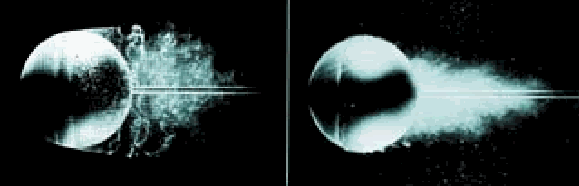
Force from drag (Fd) = .5 * Coefficient of drag (Cd) * density of air (pa) * velocity squared (V^2) * frontal area (A)
Frontal area (A) = pi * r^2
deceleration due to drag (d) = Force from drag (Fd) / mass of paintball (m)
mass of paintball (m) = volume of a sphere (4/3 * pi * r^3) * density of paint (pb)
Lets assume most of the mass in a paintball is the paint so this will be the same for either paintball and lets take all things that don't change, everything but the radius of the paintball, and group them as constants. We end up with:
deceleration (d) = constants *r^2 /r^3 = constants / r
Lets compare the deceleration based on the radius of the two different size caliber paintballs.
deceleration of .50 caliber = 4*constants
deceleration of .68 caliber = 3*constants
So it would seem that .5 cal paintball, although having less of a force of drag acting on it, will decelerate quicker due to the reduced mass of the paintball.
Your rebuttal?
I think you mean the forces are different on the balls, the rules of PHYSICS don't change with caliber.
Here we go though:
Basic physics first (No Drag).
Standard Cartesian Coordinates, horizontal shot
forward travel of a paintball (D) = velocity(V) * time(t)
time(t) = 2 * height fired from (h) / acceleration do to gravity (g)
Solve for distance D = 2*V*h/g
forward travel is a function of velocity, height fired from, gravity, not the size, mass, color, etc of the paintball.
Lets bring in fluids:
Force from drag (Fd) = .5 * Coefficient of drag (Cd) * density of air (pa) * velocity squared (V^2) * frontal area (A)
Frontal area (A) = pi * r^2
deceleration due to drag (d) = Force from drag (Fd) / mass of paintball (m)
mass of paintball (m) = volume of a sphere (4/3 * pi * r^3) * density of paint (pb)
Lets assume most of the mass in a paintball is the paint so this will be the same for either paintball and lets take all things that don't change, everything but the radius of the paintball, and group them as constants. We end up with:
deceleration (d) = constants *r^2 /r^3 = constants / r
Lets compare the deceleration based on the radius of the two different size caliber paintballs.
deceleration of .50 caliber = 4*constants
deceleration of .68 caliber = 3*constants
So it would seem that .5 cal paintball, although having less of a force of drag acting on it, will decelerate quicker due to the reduced mass of the paintball.
Your rebuttal?




Comment